

Move with confidence
Example voiceover · Brand launch
Meet the moment. Move with confidence. Every step takes you somewhere new.
Discover the key features of a modern text to speech API. Learn how to choose the right solution to enhance user experience and create unique audio.
Example projects
Example voiceover · Brand launch
Meet the moment. Move with confidence. Every step takes you somewhere new.
Explore freely. Sign up to generate your own. Examples are pre-generated.

At its core, a text to speech API is a bridge that lets your software turn written words into spoken audio automatically. It’s not just translating between languages, but from silent text into natural-sounding human speech, making your digital content instantly more engaging. This guide provides actionable insights to help you choose and implement the right API to scale your voice strategy without limits.
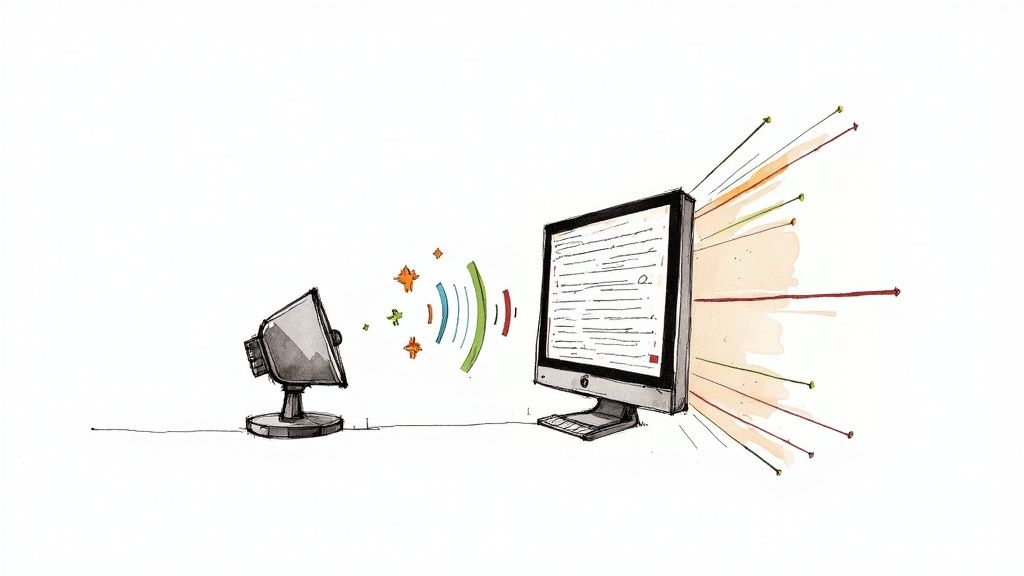
The easiest way to think of a Text to Speech API (Application Programming Interface) is as an on-demand narrator you can call up with a bit of code. Instead of the massive headache of pre-recording every single sentence your app might ever need to say, you just send the text to the API. In return, you get a crisp, clear audio file back in seconds.
This completely eliminates the need for manual voiceover work, saving a huge amount of time and money.
But this isn't just about reading words out loud. It's about building dynamic, voice-driven experiences. The API acts as the middleman, connecting your app to a powerful AI engine that has been trained on mountains of human speech data. Your app sends a request, the AI does its magic, and the finished audio is sent back for your users to hear.
This seamless back-and-forth is what powers the voice in your GPS giving directions, an e-learning app reading lessons aloud, or a news site creating an audio version of an article on the fly.
A text to speech API is more than a utility; it's a strategic tool for user engagement. It gives a voice to your digital content, making it accessible and compelling for a much broader audience.
It's no secret that the market for voice is exploding as more businesses see the value. The global Text-to-Speech market is set to jump from USD 3.87 billion to more than USD 8.32 billion by 2030. This growth is fueled by everything from smart speakers to new uses in healthcare, education, and entertainment.
This trend points to a fundamental shift in user behavior: people increasingly want to listen instead of read. A high-quality text to speech API is how you meet that demand head-on.
Many APIs out there will charge you by the character. While that might seem fine at first, it can quickly stifle creativity and lead to runaway, unpredictable costs. This is where platforms like Verbatik flip the script by offering unlimited text to speech, freeing up developers and creators to experiment and grow without constantly watching the meter.
This becomes even more powerful when you pair it with other features. For example, Verbatik also provides unlimited voice cloning, which lets you create a completely unique and consistent audio brand. This kind of freedom changes the API from a simple function into a cornerstone of your content strategy. If you're just getting started, check out our guide on the basics of text to speech technology for a deeper dive.
A text-to-speech API does more than just turn words on a page into audio. It completely changes the game for how people interact with your content. It breathes life into static text, knocking down barriers and creating new ways to connect with your audience that simply didn't exist before. This tech is the secret sauce behind a lot of the digital conveniences we now use every day.
Think about it. A long, dense article can instantly become a podcast for someone's morning commute. An educational app can read lessons aloud, giving a huge boost to students with learning disabilities or anyone who just learns better by listening. These aren't futuristic ideas—they're happening right now, all powered by a simple API call.
One of the biggest wins for TTS APIs is in making the digital world more accessible. A huge part of this comes from integrating with assistive tools like screen readers, which read on-screen text out loud for users with visual impairments. This one feature opens up the internet for millions of people who might otherwise be locked out.
But it goes way beyond that. TTS is a massive driver for user engagement because it offers choice. Some people would rather listen while they're at the gym, cooking dinner, or just giving their eyes a break. By providing an audio option, you're meeting them where they are, keeping them on your platform longer, and delivering a much more memorable experience.
This infographic breaks down some of the key differences for platforms with and without TTS.
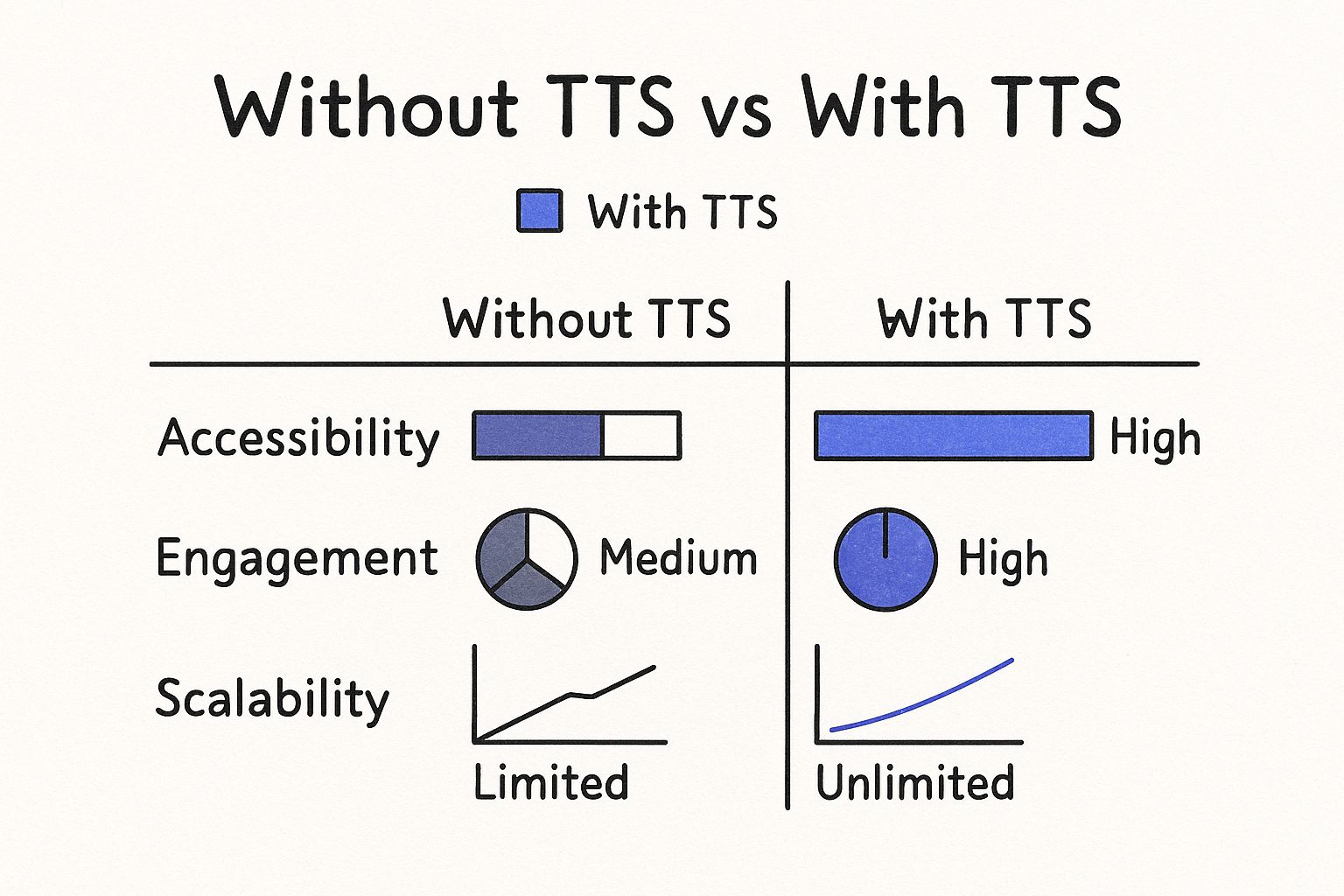
As you can see, adding a TTS solution gives a clear lift in both accessibility and engagement. And when you're not limited by character counts, you can really scale those benefits.
The use cases for a text-to-speech API are popping up everywhere, in just about every industry you can think of. From the automated voice systems in call centers to the GPS in your car giving you turn-by-turn directions, TTS is the invisible engine making technology feel more human.
Here are just a few killer examples:
The momentum is undeniable. The broader Natural Language Processing (NLP) market, which is home to TTS tech, was valued at USD 25.5 billion in 2024. Projections show it rocketing to USD 490.4 billion by 2034, fueled by the explosive growth of AI-powered voice applications.
This isn't just about a cool new piece of tech. It’s a fundamental shift in how we interact with our devices. Voice is rapidly becoming a go-to interface, and TTS is the key that unlocks its full potential.
For any business serious about integrating voice, the choice of API provider is a make-or-break decision. Old-school, pay-per-character models can really hold you back, forcing teams to count every word and think twice before trying out new ideas. This is exactly where an unlimited model becomes a massive strategic advantage.
When you use a platform like Verbatik that offers unlimited text to speech, you're free to experiment. You can deploy voice solutions across every customer touchpoint without worrying about a runaway bill. Combine that with features like unlimited voice cloning, and you can build a completely unique and consistent audio brand that scales with you. This freedom removes the financial handcuffs and lets your team build the voice-enabled experience they've always envisioned.
Choosing a text to speech API can feel like navigating a maze. Every provider claims to have the most realistic voices and the best features, making it tough to know what actually matters. To cut through the noise, you need to focus on what will make a real difference in your projects.
The right API is more than just a text reader; it’s a tool for creating audio experiences that genuinely connect with your audience. You need something that doesn’t just work, but helps you scale and innovate without hitting a wall.
Let's start with the absolute deal-breaker: voice quality. A flat, robotic voice is an instant turn-off. It makes your content feel cheap and completely disengages the listener. A top-tier text to speech API has to produce audio that sounds like a real person is speaking.
This goes way beyond just getting the pronunciation right. You need to listen for natural cadence, emotional range, and believable intonation. The best APIs use sophisticated neural networks to capture the tiny details of human speech, allowing the AI to sound happy, serious, or excited based on the context of the text.
If the voice doesn't sound human, nothing else matters. Always, always listen to samples and test the voices with your own scripts before you commit to a provider.
No two projects are the same, so a one-size-fits-all voice just won't cut it. This is where fine-grained control becomes essential. The API you choose should put you in the driver's seat, letting you tweak the audio until it perfectly matches your brand's voice and the specific needs of your content.
Here are the key customization knobs you should be looking for:
This kind of control turns your audio from a simple narration into a carefully crafted part of the user experience. You can see a full breakdown in our guide to the features and benefits of Verbatik's TTS API.
The real power of a TTS API isn't just in converting text to audio, but in giving you the director's chair. Precise control over the final output is what separates a generic tool from a professional production suite.
In a connected world, your audience isn't in just one place. A great text to speech API needs to offer a deep library of languages and accents. This lets you create localized content that speaks directly to regional audiences, making your brand feel more personal and accessible on a global scale.
But don't just look at the number of languages. Dig deeper. Does the API offer a good variety of voices—different genders, ages, and styles—within each language? Having options gives you the creative freedom to find the perfect narrator for anything, from a corporate training video to an energetic podcast ad.
While the features above are the foundation, two game-changing capabilities truly separate the best from the rest. The first is voice cloning. This tech allows you to create a perfect digital copy of a specific person's voice, giving your brand a unique and instantly recognizable audio identity. Imagine every piece of your content, from social media clips to customer support, speaking with one consistent voice.
The second is the pricing model. Traditional pay-per-character plans are a creativity killer. You're constantly counting characters and worrying about costs, which stifles experimentation. In stark contrast, Verbatik’s model of unlimited text to speech shatters those financial barriers. It frees up your team to integrate audio everywhere and scale your projects without worrying about a massive bill at the end of the month.
Not all API plans are created equal. The difference between a pay-per-use model and an unlimited plan can drastically impact your budget, workflow, and ability to scale. Here’s a quick look at how they stack up.
| Feature/Model | Typical Pay-Per-Use API | Verbatik's Unlimited Model |
|---|---|---|
| Cost Structure | Pay per character/word, often with complex tiers. | Simple, flat-rate subscription. |
| Budgeting | Unpredictable. Costs scale directly with usage. | Predictable. One fixed cost for unlimited generation. |
| Scalability | Cost-prohibitive for large-scale projects. | Easily scalable without financial penalties. |
| Experimentation | Discouraged. Every test run costs money. | Encouraged. Create and iterate without limits. |
| Voice Cloning | Often a premium, high-cost add-on. | Included in the plan, often with unlimited cloning. |
As you can see, an unlimited model fundamentally changes how you can approach audio content. It shifts the focus from managing costs to maximizing creative output.
When you combine unlimited voice cloning with unlimited TTS generation, you get an incredible strategic advantage. You can develop a one-of-a-kind brand voice and deploy it across all your channels without ever thinking about the cost.
Giving your application a voice might sound like a huge technical hurdle, but with a modern text to speech API, the process is surprisingly simple. It’s less about wrestling with complicated code and more about connecting a few dots. Let's walk through the core steps and pull back the curtain on how it all works, whether you're a developer or a product manager.
The whole point of a well-designed API is to make your life easier. It does all the heavy lifting—the complex AI voice generation—behind the scenes. All you have to do is send it some text, and in return, you get a finished audio file ready to play.
First things first: authentication. Think of your API key as the unique, secure password that lets your application talk to the TTS service. It's a special string of characters that identifies your project and proves you have permission to make requests.
Getting your key is almost always a quick, painless process:
This key is the digital handshake between your app and the API, confirming your identity before any data gets passed back and forth.
With your API key ready, it’s time for the fun part: bringing your text to life. An API call is just a structured request that your application sends to the API's server. This request packages up the text you want to convert, your API key for authentication, and any extra instructions you want to include, like the voice, language, or speaking speed.
The general flow looks something like this:
For a more hands-on walkthrough, our guide on integrating Verbatik's TTS API into your business offers code snippets and practical examples to get you up and running in no time.
While the specific code depends on your programming language—whether it’s Python, JavaScript, or something else—the underlying logic is always the same. Here’s a simplified look at what a basic request might look like in pseudocode, which is just a human-friendly version of code.
// 1. Set up your API key and the endpoint URL
API_KEY = "your_secret_api_key_here"
API_ENDPOINT = "https://api.verbatik.com/v1/tts"
// 2. Prepare the data you want to send
request_data = {
"text": "Hello, world! This is my first audio generation.",
"voice_id": "male_professional_1",
"language": "en-US"
}
// 3. Send the request, including your key for authentication
response = send_post_request(
url = API_ENDPOINT,
headers = {"Authorization": API_KEY},
data = request_data
)
// 4. Take the audio file from the response and save it
save_audio_file(response.audio_content, "hello_world.mp3")
This little example shows all the key pieces: authentication, the data payload, and what to do with the response. The entire system is built for clarity and speed, letting you turn an idea into a working voice feature incredibly fast.
The goal of a developer-friendly API is to remove friction. The integration shouldn't be a week-long project; it should be an afternoon task that immediately adds value to your application.
After the API works its magic, it sends the audio data back to you. This usually arrives as a binary file, like an MP3 or WAV. Your application then needs to know what to do with it.
You really have two main choices here:
The right method is all about your specific use case. The flexibility to either stream or save opens up a huge range of possibilities for voice-enabled features. With a platform like Verbatik, you don't have to stress about the volume of these requests. Its unlimited text to speech model lets you generate audio for every user, article, or notification without ever hitting a limit. And when you pair that with unlimited voice cloning, you can deliver all of that audio in your own unique brand voice, scaling your entire audio strategy without constraints.

While a huge library of AI voices gives you plenty of options, voice cloning is where a text to speech API really starts to feel like a superpower for your brand. This is where you move past picking a pre-made voice and instead create a perfect digital twin of a specific person's voice.
Think of it this way: you could use a stock photo for your website, or you could hire a photographer for a custom shoot that perfectly nails your brand's vibe. Voice cloning is the custom photoshoot for your audio.
Imagine every single audio touchpoint—from ads and tutorials to your customer support system—all speaking in one consistent, instantly recognizable voice. You're no longer settling for a voice that's "good enough." You're building an audio identity that's 100% yours, building trust and familiarity with every listener.
Your brand's voice is just as important as its logo or color scheme. Voice cloning lets you define and own that audio identity completely. By cloning the voice of a founder, a beloved spokesperson, or a professional voice actor, you create a unique asset that you can roll out across any channel in an instant.
This kind of consistency has a real impact on your audience. Hearing the same friendly, helpful voice in a podcast ad, an online course, and a follow-up call makes your brand more memorable and strengthens the customer relationship. It makes your company feel more human and connected.
To see just how powerful this can be, it's worth checking out how custom voices can be paired with visual content. For a great example, look at Mindstamp's integration with AI video platforms like Synthesia.
Voice cloning transforms your audio from a simple utility into a strategic branding asset. It establishes a consistent, memorable, and trustworthy audio identity that sets you apart from the competition.
For creators, marketers, and educators, the pressure to produce high-quality audio content never stops. Voice cloning offers a way to scale up that production without losing that authentic, human touch. A YouTuber can narrate an entire video series in their own voice without spending days on end in a recording booth.
The possibilities here are massive. An ad agency could generate thousands of personalized ad variations, each targeting a specific customer, all narrated in the brand's signature voice. An e-learning company could update its entire course library overnight, ensuring every single lesson is delivered with the same clear, consistent instruction.
To get a better sense of how the technology works under the hood, you can check out this deep dive into voice cloning technology.
This is where picking the right API provider makes all the difference. Some platforms, like Verbatik, not only make voice cloning easy to access but also bundle it with an unlimited text to speech plan. That combination is a game-changer.
It means you can create your brand's unique voice and then use it as much as you want without ever hitting a character limit or getting hit with surprise fees.
This freedom lets you build out a complete audio strategy without cutting corners. You can experiment with new ideas, scale up your content, and weave your brand's unique voice into every corner of your business. It removes the budget headaches that often hold companies back and turns a sophisticated technology into a simple, powerful tool for building a brand people remember.
When you're picking a text to speech API, it's about more than just slick features and voice quality. The pricing model alone can make or break your entire strategy. Think of traditional pay-per-character APIs as driving with the emergency brake pulled—they create unpredictable costs and force your teams to ration every word, killing innovation before it even starts.
This old-school model puts a price tag on every single experiment. Want to test a new voice feature on a small group of users? Ka-ching. Thinking about turning your entire blog archive into audio? The bill for that could be massive. This kind of financial friction is the enemy of the very creativity that leads to your next big win.
An unlimited model completely flips the script. It gets rid of the meter-watching anxiety and frees up your developers, marketers, and content creators to really dig in and explore what voice can do. With a provider like Verbatik that offers unlimited text to speech, that financial roadblock just vanishes.
Adopting an unlimited TTS API shifts your team's focus from counting characters to creating value. It transforms audio from a line-item expense into an integral, scalable part of your entire business strategy.
This freedom means you can weave voice into every customer touchpoint without worrying about a surprise invoice. You can give your support team instant audio replies, create audio versions of every blog post and ad, and build truly immersive product experiences. It creates a culture where bold ideas can be tested and rolled out fast.
Trying to scale a project on a pay-per-use plan is a recipe for blowing your budget. As your audience grows, your API bill grows right along with it, basically penalizing you for being successful. An unlimited plan, on the other hand, is built for growth. It gives you a predictable, flat-rate cost that lets you scale your audio ambitions without financial punishment.
This predictability is a massive advantage for long-term planning. You can confidently map out your voice strategy knowing your costs are locked in, whether you're serving one thousand users or one million. For any business serious about growth, that’s a critical edge. For a deeper dive, you can explore strategies for leveraging text-to-speech technology for business growth and see how an unlimited model is the fuel for expansion.
Here’s exactly how an unlimited approach drives business growth:
At the end of the day, an unlimited text to speech API is about more than just saving money. It's an investment in creative freedom and scalable growth. It allows you to stop putting limits on your audio ambitions and start building a voice strategy that's truly ready for the future.
Still have a few questions floating around about how a text to speech API actually works? Let's clear them up with some straightforward answers to the most common things developers and creators ask.
Honestly, they're shockingly good. Today's neural TTS APIs can generate voices that are practically indistinguishable from a human speaker. They nail the subtle stuff—intonation, emotional shifts, and natural rhythm.
Of course, quality isn't the same everywhere. It's always a smart move to listen to a few voice samples from any provider before you decide to jump in.
Pricing is all over the map in this industry. A lot of providers stick to a pay-per-character or per-request model, which sounds fine until your app starts to take off. Then it becomes a huge, unpredictable expense that can actually discourage you from building cool new things.
The real game-changer is the pricing model. Platforms offering predictable, flat-rate subscriptions are taking the financial guesswork out of the equation, letting you build without limits.
This is where some services are flipping the script. For instance, Verbatik offers unlimited text to speech for a simple subscription fee. This completely changes the dynamic, letting you budget easily and use voice everywhere without constantly checking your usage meter.
Not anymore. While the tech behind it is definitely complex, the best APIs have made the process incredibly simple on the user's end. With a platform like Verbatik, you can create a perfect digital copy of a voice with just a few clicks.
It's a straightforward process:
This approach makes unlimited voice cloning a practical tool instead of a complicated science project. It's an accessible way to build a completely unique brand identity.
Ready to stop worrying about character limits and unlock your brand's unique voice? Explore Verbatik's unlimited text-to-speech and voice cloning platform to start creating without constraints. Get started with Verbatik today!
Join 150,000+ creators, developers, and businesses using Verbatik AI to produce studio-quality voiceovers, clone voices, and generate music and sound effects.
150K+
creators
150+
languages
75ms
latency
Trusted by teams at leading companies worldwide


